Graphite Heat Exchangers
Our graphite heat exchanger offers reliable heat transfer solutions for corrosive chemical processes. Graphite heat exchangers feature exceptional corrosion resistance and are widely applied in highly corrosive operating conditions. Typical process scenarios include: hydrochloric acid production in the chlor-alkali chemical industry, sulfuric acid processes in titanium dioxide manufacturing, wet-process phosphoric acid heat exchange, hydrogen fluoride in fluorine chemical processes, and chloromethane-related processes, as well as various halogen acid systems in the pharmaceutical and pesticide sectors.
Additionally, they are well-suited for a variety of highly corrosive heat exchange scenarios including organic synthesis, fine chemicals, rare earth smelting, hydrometallurgy, pickling and passivation, fragrance synthesis, solid/hazardous waste resource recovery, and electroplating pickling. They are fully adaptable to media of various concentrations of hydrochloric acid, sulfuric acid below 70%, phosphoric acid, and various corrosive salt solutions.
We supply machined graphite components and complete units for industrial corrosion‑resistant thermal exchange applications.
Product Overview
Graphite heat exchanger is widely deployed inside chemical production facilities to handle strongly corrosive acids and chemical fluids. Thanks to graphite’s unique combination of good thermal conductivity and outstanding chemical inertness, this industrial thermal‑transfer equipment can work reliably where many metallic heat‑exchange devices quickly corrode. There are two main structural designs: block‑hole graphite type and graphite shell‑and‑tube type, to satisfy diverse process parameters. We support custom dimension development according to plant working conditions.
Material & Performance
High‑density impregnated graphite forms the core material for this equipment. Impregnation treatment effectively seals graphite’s natural open pores, preventing fluid penetration and leakage under working pressure. Two common impregnation resin options are phenolic resin and furan resin. Phenolic resin‑impregnated graphite works well for most non‑oxidizing acidic media, while furan resin‑impregnated graphite delivers improved temperature‑resistance and better alkali resistance. The material retains stable heat‑conducting properties even when exposed to hot corrosive media.
Structural Types of Graphite Heat Exchangers
Graphite heat exchangers are widely used in chemical, fine chemical, pharmaceutical, pesticide, hydrometallurgy, and other industries for heating, cooling, condensation, evaporation, and absorption of corrosive media, thanks to their excellent resistance to strong corrosion and superior thermal conductivity. By structural form, they are mainly divided into three types: cylindrical block hole graphite heat exchangers, cubic block hole graphite heat exchangers, and shell and tube graphite heat exchangers.
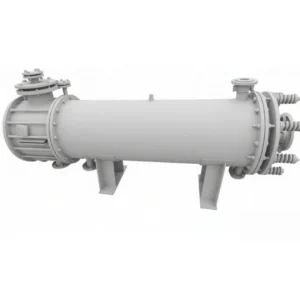
1. Cylindrical Block Hole Graphite Heat Exchanger
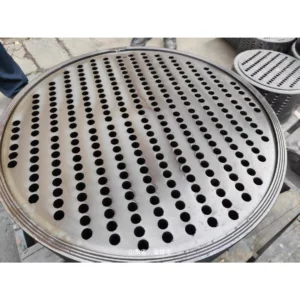
It is assembled from multiple circular impermeable graphite heat exchange blocks stacked together. Inside each block, two sets of mutually perpendicular medium flow channels are machined. Hot and cold media exchange heat through the partition walls of the graphite blocks. The complete unit is equipped with a spring pre-tensioning compensation mechanism to absorb thermal expansion and contraction displacement.
-
Advantages: High thermal conductivity, low coefficient of linear thermal expansion, and strong thermal shock resistance; building-block stacking assembly for easy maintenance and disassembly; suitable for harsh conditions with high temperature, large temperature difference, and relatively high pressure.
-
Executive Standard: HG/T 3113-2019
“For detailed high-temperature operating characteristics of our graphite round block heat exchangers, please visit our product info page.”
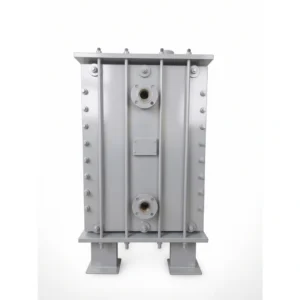
2. Cubic Block Hole Graphite Heat Exchanger
The heat exchange unit is a square cubic graphite block, with horizontal and vertical holes drilled to form medium flow channels. The equipment is an overall square box structure, using long tie-rod bolts to fasten and compress the graphite heat exchange modules.
-
Advantages: Flexible heat exchange process configuration, enabling multi-pass design; compact equipment structure with outstanding performance in condensation conditions; suitable for corrosive heat exchange and condensation absorption processes at medium temperature and medium pressure.
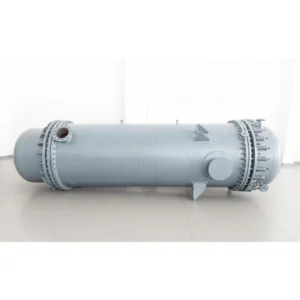
3. Shell and Tube Graphite Heat Exchanger
The shell is a steel outer shell, and the internal heat exchange tube bundle uses YFSG pressed graphite tubes; they are produced by mixing and extruding graphite powder with phenolic resin, with no impregnation process; available in two grades: low-temperature heat treatment YFSG1 and high-temperature heat treatment YFSG2.
-
Advantages: Relatively economical overall equipment cost; standard cylindrical shell structure; floating head structure is preferred to release thermal expansion stress of the tube bundle.”Ideal for large heat transfer areas and operating conditions involving fouling media prone to clogging.”
-
Limitations: The tube material has a relatively large coefficient of linear thermal expansion and high thermal stress risk; thermal conductivity is weaker than that of block hole components; mostly used for conventional mild-temperature heat exchange conditions.
-
Tube Executive Standard: HG/T 2059-2014
“For detailed anti-clogging and easy-cleaning capabilities, please visit our shell and tube graphite heat exchanger product page.”
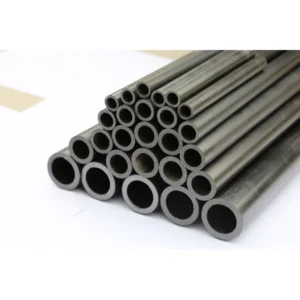
In addition, we supply graphite tubes for tubular graphite heat exchangers, available for your manufacturing, maintenance and replacement of tubular graphite heat exchangers.
Custom Options
We offer two cooperation modes for your project. Customers may supply finished drawings for us to proceed with machining and production. Alternatively, you can provide working data including flow rate and temperature of process media, and our technical team will develop a tailored design solution accordingly.
We provide both graphite spare parts and whole graphite heat exchanger assemblies. Drawing‑based custom manufacturing is available for block graphite heat transfer blocks, tube elements and related fittings. Customers may select preferred impregnation resin grade and equipment construction style based on actual process conditions. Our engineering team can review your process parameters including working temperature, pressure and medium properties, to recommend suitable construction solutions for your chemical plant project.
Quality & Delivery
Strict dimensional inspection and leak testing are performed for every graphite component. Since graphite is brittle, shock‑absorbing packaging is essential for export shipment. Reinforced wooden cases are adopted to prevent cracking and edge damage during long‑distance transportation.
Application
Chemical processing plants, fine‑chemical production, non‑ferrous metallurgy, waste‑acid recovery systems. These industrial graphite heat‑exchange units are used for cooling, heating and condensing aggressive acidic process media.
Note:
Currently, the stably and commercially mass-supplied option on the market is phenolic resin-impregnated graphite heat exchangers. Its limitations are that it is not resistant to nitric acid, concentrated sulfuric acid above 70%, strong alkalis such as sodium hydroxide solutions, certain concentrations of phenols, aldehydes, and some solvents with strong dissolving properties. If you encounter these types of media, we recommend using the more stable and suitable silicon carbide tube heat exchangers.
Showing all 6 results