
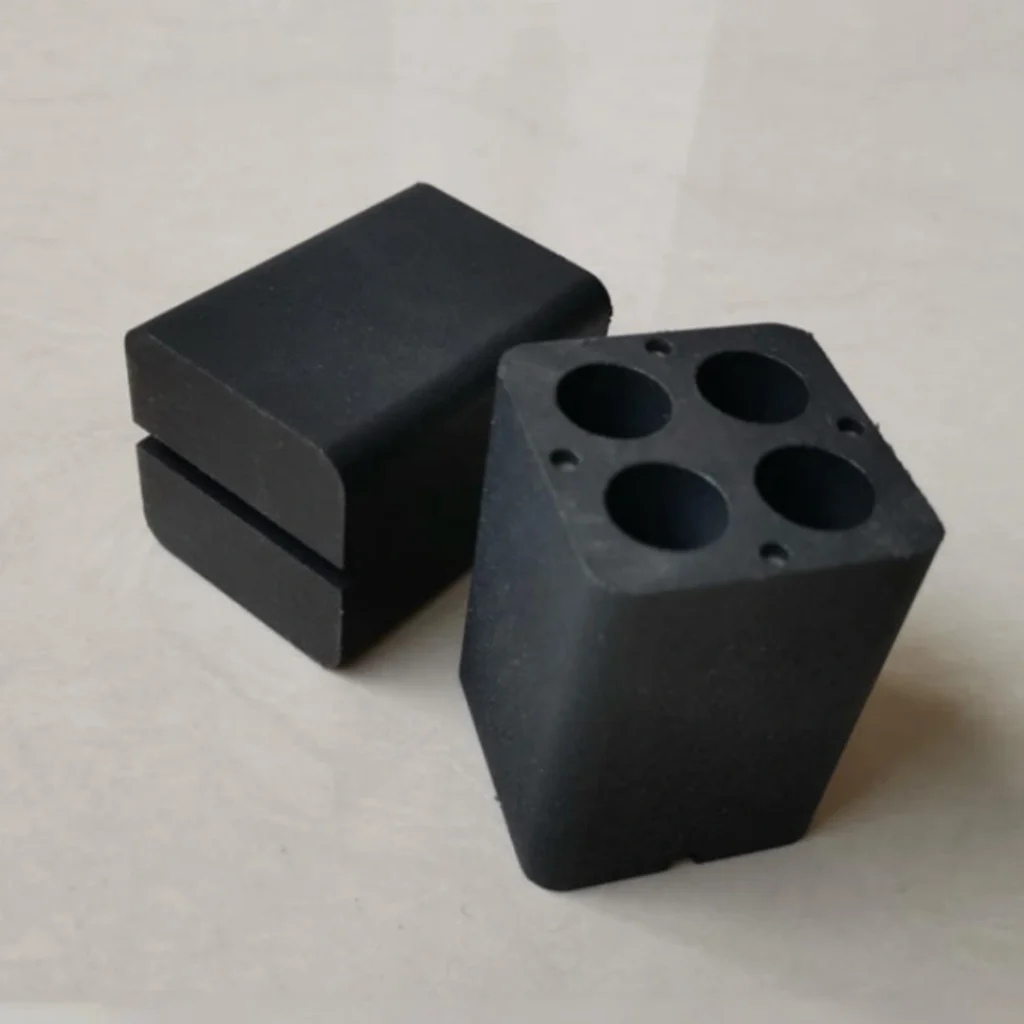
Graphite electrodes and heat exchangers are essential high-temperature conductive materials used in electric arc furnace steelmaking, phosphorus and silicon production, and various corrosive chemical processes. But how are these materials made? What raw materials are used, and what manufacturing steps transform them into reliable industrial components? This guide walks you through the complete process—from raw material selection to final machining—and explains the key quality standards and performance drivers behind graphite electrodes and heat exchangers.
I. Raw Materials: The Foundation of Quality
Graphite electrodes and heat exchangers are produced through a series of processes including mixing, molding, baking, impregnation, graphitization, and machining. The three key raw materials are:
-
Petroleum coke
-
Needle coke
-
Coal tar pitch (used as a binder)
These materials enable arc furnace steelmaking, where electrical energy is converted into heat exceeding 3,000°C via electrodes. They are also used in phosphorus, silicon, and abrasive production.
1. Petroleum Coke
Petroleum coke is a carbon-rich solid byproduct of petroleum refining. It is classified by:
-
Heat treatment:
-
Green coke (high volatiles, low strength)
-
Calcined coke (processed at 1,250–1,350°C)
-
-
Sulfur content:
-
Low-sulfur (<0.5%, preferred for electrodes)
-
Medium-sulfur (0.5–1.5%)
-
High-sulfur (>1.5%)
-
2. Needle Coke
Needle coke is an anisotropic coke with a fibrous texture and ultra-low thermal expansion. It is critical for:
-
High-power (HP) and ultra-high-power (UHP) electrodes
-
Low resistivity (≤500 μΩ·m) and high thermal shock resistance
Types include oil-based (from petroleum) and coal-based (from coal pitch).
3. Coal Tar Pitch
Coal tar pitch is a viscous binder with:
-
Softening points: Low (≤80°C), Medium (80–110°C), High (>110°C)
-
Roles:
-
Binder pitch: High coking value, β-resin content
-
Impregnation pitch: Low QI (quinoline-insoluble), good fluidity
-
II. Manufacturing Process: Step by Step
1. Calcination
-
Purpose: Remove volatiles, enhance density and conductivity.
-
Equipment: Rotary kilns, shaft furnaces (1,250–1,350°C).
-
Quality control:
-
Petroleum coke: Density ≥2.07 g/cm³, resistivity ≤550 μΩ·m
-
Needle coke: Density ≥2.12 g/cm³, resistivity ≤500 μΩ·m
-
2. Crushing & Formulation
-
Particle sizing: Jaw/roller crushers (0.5–20 mm), ball mills (<0.075 mm).
-
Formulation principles:
-
Optimal particle packing (large + fine grains)
-
Binder content: 18–24%
-
3. Mixing (Kneading)
-
Stages:
-
Dry mixing (20–35 min): Uniform particle distribution.
-
Wet mixing (40–55 min): Pitch coating for plasticity.
-
4. Molding Methods
| Method | Equipment | Products |
|---|---|---|
| Extrusion | Hydraulic press | Electrodes, square blocks |
| Vibration molding | Vibratory compactors | Carbon bricks for aluminum |
| Isostatic pressing | CIP/HIP machines | Isotropic graphite |
5. Baking
-
Purpose: Carbonize pitch binder (1,000–1,250°C, 22–30 days).
-
Effects:
-
Mass loss: 8–10%
-
Resistivity drop: 10,000 → 40–50 μΩ·m
-
-
Furnace types: Ring kilns, tunnel kilns.
6. Impregnation
-
Process: Vacuum-pressure cycling (1.2–1.5 MPa, 180–200°C).
-
Target: ≥14% weight gain (first impregnation).
7. Graphitization
-
Acheson/LWG furnaces heat to 2,300–3,000°C, transforming amorphous carbon into crystalline graphite.
-
Outcomes:
-
Resistivity: ↓4–5×
-
Thermal conductivity: ↑10×
-
Ash content: ≤0.3%
-
8. Machining
-
Electrode threading: CNC lathes for conical/cylindrical joints.
-
Tolerances: ±0.05 mm (diameter), ±1° (taper).
III. Quality Standards: Key Metrics for Graphite Electrodes
| Parameter | RP Electrodes | HP Electrodes | UHP Electrodes |
|---|---|---|---|
| Resistivity (μΩ·m) | ≤8.5 | ≤6.5 | ≤5.5 |
| Density (g/cm³) | ≥1.53 | ≥1.62 | ≥1.67 |
| Flexural strength (MPa) | ≥8.5 | ≥10.5 | ≥11.0 |
| Thermal expansion (10⁻⁶/°C) | ≤2.9 | ≤2.4 | ≤1.5 |
Performance Drivers:
-
Low resistivity: Achieved through high graphitization and dense structure.
-
Thermal shock resistance: Optimized coke/pitch ratios.
IV. Applications in Steelmaking
1. Electric Arc Furnace (EAF) Process
-
Advantages:
-
Uses 100% scrap metal (vs. iron ore in blast furnaces).
-
Energy efficiency: 60–70% (vs. 40% for converters).
-
-
Electrode consumption mechanisms:
-
Tip erosion (sublimation + slag reactions).
-
Sidewall oxidation (50% of total loss).
-
Thermal spalling (cracking from rapid cooling).
-
2. Industry Trends
-
UHP furnaces: Demand electrodes with ≤5.5 μΩ·m resistivity.
-
Automation: Robotic electrode handling to reduce breakage.
V. Technical Glossary
-
CTE (Coefficient of Thermal Expansion): Critical for thermal stress resistance.
-
Thermal Shock Factor (K): K = E·α / σ·λ
-
Where:
-
σ = Tensile strength
-
λ = Thermal conductivity
-
E = Elastic modulus
-
α = CTE
-
-
Final Thoughts
From raw material selection to precision machining, every step in the manufacturing of graphite electrodes and heat exchangers directly impacts performance, durability, and efficiency. Understanding the role of petroleum coke, needle coke, and coal tar pitch—and how processes like calcination, molding, baking, impregnation, and graphitization shape the final product—helps manufacturers and buyers make informed decisions. Whether you are producing UHP electrodes for steelmaking or corrosion-resistant graphite heat exchangers for chemical processing, quality control at every stage is the key to reliable, long-lasting performance.