
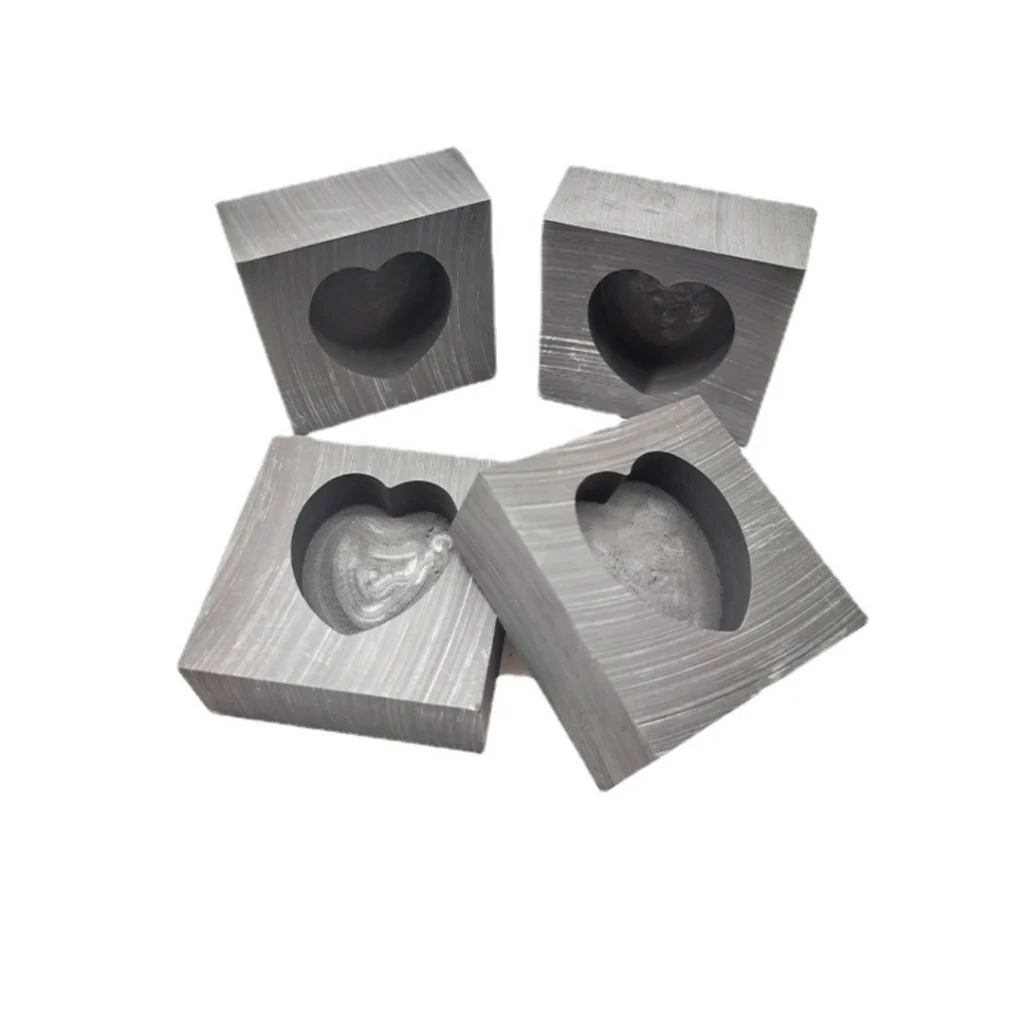
Many R&D laboratories and small hot-press/sintering factories are studying how to make graphite molds. Thanks to its high-temperature resistance, good thermal conductivity, and easy machinability, graphite is a classic mold material for high-temperature sintering, non-ferrous metal forming, and hot-press processes. Making graphite molds in-house generally involves several stages: material selection, rough machining, finish machining, and surface post-treatment. However, the factor that truly determines mold life, precision, and cost is often the first step—material selection. Below are core data recommendations for graphite mold selection, followed by the complete production process.
Graphite Mold Selection Data Recommendations (Quick Reference)
| Selection Item | Recommended Range/Advice | Notes |
|---|---|---|
| Graphite Type | Isostatic graphite preferred | Isotropic, uniform structure, good thermal shock resistance, suitable for precision molds |
| Grain Size | Ultra-fine ≤5 μm; fine 5–15 μm; medium 15–30 μm; coarse >30 μm | The finer the grain, the better the surface finish, but the higher the cost |
| Bulk Density | ≥1.80 g/cm³; high requirement ≥1.85 g/cm³ | Higher density means better strength and penetration resistance |
| Flexural Strength | ≥40 MPa; high requirement ≥60 MPa | Withstands hot-press, clamping, and thermal cycling stress |
| Compressive Strength | ≥80 MPa; high requirement ≥100 MPa | Key indicator for pressure-bearing molds |
| Ash Content | Ordinary ≤0.1%; high purity ≤0.05%; ultra-high purity ≤0.01% | Avoids workpiece contamination; high requirements for semiconductors/precious metals |
| CTE (RT–600°C) | ≤5×10⁻⁶/°C; preferred ≤4×10⁻⁶/°C | Lower values mean better thermal shock resistance |
| Thermal Conductivity | ≥100 W/(m·K); preferred 120–160 | Affects heating uniformity and cycle time |
| Post-treatment | Impregnation or SiC coating as needed | Improves penetration resistance, oxidation resistance, and service life |
Typical Application Selection Recommendations:
-
Precision hot-press molds, mirror finish requirements: ultra-fine/fine grain isostatic graphite, density ≥1.85 g/cm³, ash ≤0.05%.
-
General hot-press sintering molds: fine/medium grain isostatic graphite, density ≥1.80 g/cm³, flexural strength ≥40 MPa.
-
Large-size, low-cost molds: medium/coarse grain graphite, density ≥1.75 g/cm³, flexural strength ≥30 MPa.
-
Strong corrosion or high-purity conditions: high-purity isostatic graphite + resin impregnation or SiC coating.
I. Complete Graphite Mold Production Process
-
Graphite Base Material Selection
Isostatic graphite blanks are preferred, and grain size is selected according to precision requirements. Molds need to balance strength and thermal shock resistance. Depending on working conditions, consider whether subsequent impregnation treatment is needed to improve penetration resistance and oxidation resistance. The finer the grain, the better the surface finish of the finished mold, but the higher the blank cost. -
Rough Machining and Blank Cutting
This is the step with the largest cutting volume and the most waste. From a large graphite blank, milling and cutting are carried out according to the drawing outline to remove a large amount of excess material, leaving a finishing allowance. Rough machining usually uses band saws, milling machines, and CNC rough milling, with a allowance of 0.5–2 mm per side (adjusted according to size and precision requirements). Rough machining is time-consuming, generates a lot of dust, and has a high material loss rate. It is also the process many machining shops least want to invest labor hours in. -
Finish Machining
Based on the rough-machined blank, high-precision CNC and grinding equipment are used to machine to the final dimensional tolerance and surface requirements. Many customers already have finish machining machine tools and processes. For them, rough machining and blank cutting are purely labor-intensive work. They prefer to keep the core precision control and final forming in their own factory to protect process confidentiality. -
Post-treatment (Optional)
According to working conditions, select impregnation or anti-oxidation coating treatment to improve mold service life and reduce high-temperature oxidation loss. Common post-treatments include phenolic/furan resin impregnation, metal impregnation, and SiC coating.
II. New Industry Approach: Purchase Pre-Roughed Graphite Blanks and Do Finish Machining In-House
If you have in-house finish machining equipment, you do not need to purchase a full-size large blank and cut it yourself, nor do you need to directly purchase a complete finished graphite mold.
We can perform rough machining of graphite molds according to your drawing requirements and deliver blanks with finishing allowance reserved.
-
Save on the purchase cost of large graphite blanks and blank cutting labor hours, and reduce waste loss;
-
After the blank is delivered to your factory, you can directly perform finish machining and independently control dimensional tolerances and core processes;
-
Faster delivery, shorter project trial production cycles, and more flexible process solutions.
Suitable scenarios: new material R&D, small-batch trial production, hot-press sintering molds, non-ferrous metal forming molds, etc.
III. Common Notes
-
The allowance for rough-machined blanks can be agreed according to your process requirements.
-
We only perform rough machining; we do not do final precision forming. Final finish machining is completed at your site.
-
Isostatic graphite is available as the base material, and drawing-based custom machining is supported.
-
Please provide complete drawings (STEP/IGS/PDF/DWG) and specify critical tolerances, surface requirements, operating temperature, media, and other working condition information.
-
If impregnation or coating is required, please specify in advance so the corresponding treatment can be arranged after rough machining.
Contact Us
If you need custom rough-machined graphite blanks with finishing allowance, please send drawings for evaluation and quotation. Our engineering team will recommend suitable graphite grades, grain sizes, and allowance plans based on your working conditions.Learn More About Custom Graphite Molds